
After a Houston hailstorm or windstorm, the insurance adjuster’s visit decides how much of your repair actually gets covered. Knowing what happens before that appointment puts you in a much stronger position.
Most homeowners meet an adjuster once every several years, while the adjuster inspects dozens of roofs in a single week. That experience gap is the biggest reason valid storm damage gets underpaid or missed entirely.
A prepared homeowner walks away with a more complete estimate than one who waits for the adjuster to lead. At Big Easy Roof Claims, we document storm damage in detail, and you can contact us today to request a free claim review before your adjuster visit.
An adjuster’s job is to inspect your property, estimate the covered damage, and set the dollar figure your insurer will pay. Understanding who is involved, what they look for, and how the timeline unfolds keeps surprises off the table.
Three different people can touch your claim, and their roles are not interchangeable. Texas law draws a hard line between them, especially around who is allowed to negotiate.
| Role | What They Do | What They Can’t Do |
|---|---|---|
| Insurance adjuster (company or independent) | Inspects your roof and writes the estimate on behalf of your insurer | Is not working for you; their job is the insurer’s interests |
| Licensed public adjuster | Can negotiate and adjust the claim on your behalf for a fee | Cannot also perform the repairs on the same property under Texas law |
| Your roofing contractor (us) | Documents the damage, builds the repair scope, meets the adjuster on-site to point it out | Cannot negotiate or settle your claim for you under Texas law |
That last distinction matters more than most homeowners expect. We can show an adjuster exactly what we found and hand over the proof, but the negotiation itself stays with you or a licensed public adjuster you hire. Knowing this up front means you line up the right help instead of trusting a promise no Texas roofer can legally keep.
The clock starts the day the storm hits, so the smartest first move is to report damage promptly and book an inspection. Texas gives you up to two years to file suit on a property claim, but your policy expects prompt notice, and waiting only makes damage harder to prove.
Once you file, the insurer assigns an adjuster who usually inspects within one to two weeks, depending on how many claims the storm generated across the area. After the inspection, you receive a written estimate, any approved repairs move forward, and replacement-cost policies release held funds once the work is finished.
From our first inspection to a completed roof, most of our Houston projects run two to four weeks, with one point of contact keeping you updated at every stage so you are never guessing where the claim stands. If a widespread storm slows the insurer’s response, that delay is normal and does not weaken your claim as long as you reported the damage promptly.
An adjuster is trained to separate storm damage from normal wear, and that line decides what gets covered. Knowing what they check helps you make sure nothing legitimate gets written off as old age.
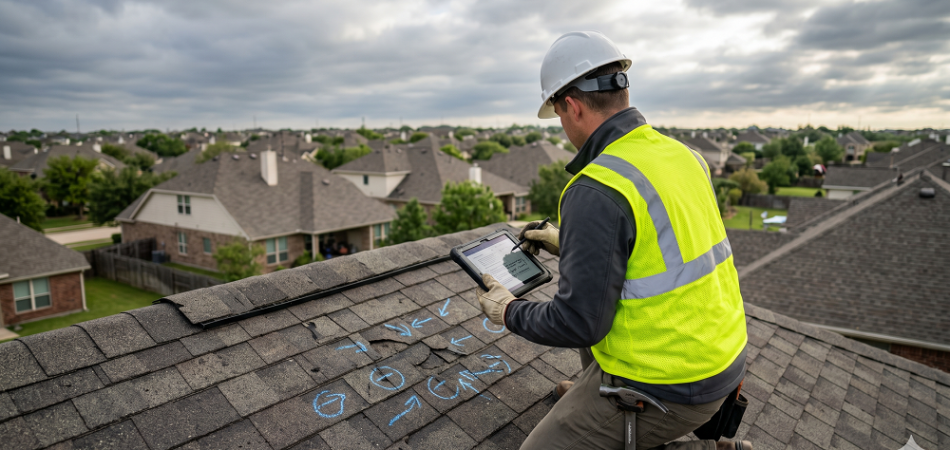
On a typical Houston inspection, an adjuster examines several areas closely:
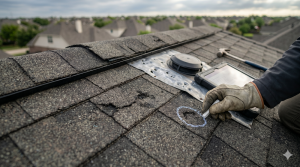 Hail bruising and granule loss: soft spots and bald patches on shingles that signal impact damage.
The challenge is that wear and storm damage can look similar from the ground. Our documentation pairs each finding with the storm date and close-up imagery, so the covered damage is easy to distinguish from ordinary aging. That distinction is often what decides whether a full slope gets approved or written off, which is exactly why clear records are worth the effort.
Your documentation is the foundation of the entire claim. The more complete it is before the adjuster shows up, the harder it is for covered damage to slip through.
Build your evidence file as soon as it’s safe to do so:
We back this up with drone imagery and a full roof inspection, so your file includes the views an adjuster cannot always reach safely. Strong documentation also protects you later: if the first estimate misses something, the photos and measurements you gathered on day one become the evidence that supports a supplement. Thorough records are the single biggest factor in a claim that reflects the real damage.
Reading your policy before the adjuster arrives tells you what to expect from the estimate. You want to know your coverage type, your deductible, and any exclusions that apply to wind or hail.
A few terms decide how much you actually receive:
Knowing these numbers ahead of time means the adjuster’s estimate has context. If your policy is replacement cost, you also know to expect two payments rather than one, which keeps the math from catching you off guard when the first, smaller check arrives.
Being on-site during the inspection is one of the highest-value hours you can spend on your claim. You see what the adjuster sees, and nothing gets recorded without your input.
 Walk the property with the adjuster and point out every area of concern from your damage list. Ask which items are being included and which are not, and write down the answers so you have a record of what was discussed. We meet the adjuster on the roof with you, point out the storm damage we documented, and make sure the hard-to-reach slopes and penetrations get a proper look.
This is coordination and proof, not negotiation, and it keeps the inspection grounded in what is actually on your home rather than a quick view from the driveway. The hour you spend here often shapes the entire estimate that follows. If your schedule makes attending impossible, arrange for someone you trust to be there, take notes, and capture photos in your place.
When the estimate arrives, read it line by line rather than skimming the total. The bottom-line number means little until you confirm the scope behind it.
Lay the estimate next to your documentation and check for gaps:
Missing or undervalued items are common, and they are usually honest oversights rather than bad faith. Adjusters work fast and cover a lot of homes after a major storm, so details get skipped.
We compare the estimate against our own scope and flag anything that does not match the damage on record, so you know exactly where the differences are and have specifics to raise before you respond. Catching a gap at this stage is far easier than reopening a claim after the paperwork is settled.
A low estimate or an initial denial is not the end of the road. Texas claims often turn on documentation, and a thin first inspection can be revisited with stronger proof.
Here is how homeowners move a stalled claim forward:
Our role is to supply the documentation that supports a re-inspection or supplement, and our storm damage insurance claims team keeps those inspection reports ready when you need them. A denial often comes down to missing evidence rather than a final verdict, so fresh documentation can reopen the conversation. For a closer look at next steps, see the guidance on what to do if your claim is denied.
Once the claim is approved, the money usually arrives in stages rather than all at once. Understanding the flow keeps the repair on schedule and your payments straight.
 Most replacement-cost claims pay the actual cash value first, then release the held depreciation after the work is finished and invoiced. You pay your deductible to the contractor as your share, schedule the repair, and submit the final paperwork so the remaining funds are released. We handle the build under one project manager, coordinate the free damage assessment and scope from the start, and provide the completion documentation your insurer asks for, backed by a workmanship warranty on the finished roof.
From there, your home is restored and your claim closes out cleanly, with the paperwork trail your insurer needs on file. Keeping your own copies of every check, invoice, and approval also makes the final depreciation release go smoothly.
An adjuster’s estimate is only as complete as the damage that actually gets documented, and that is where most Houston claims fall short. Walking into the inspection with thorough photos, a clear scope, and a contractor beside you changes the outcome.
At Big Easy Roof Claims, we inspect your roof, document every covered detail, and stand with you at the adjuster meeting. Call us at (832) 924-6251 to schedule your free storm damage assessment today!
A single weather-related claim should not. Under Texas Insurance Code Chapter 1953, insurers cannot use one act-of-nature claim, like hail or wind, to surcharge your premium or refuse to renew your policy. Rate consequences generally apply only after multiple claims within a short period, so a one-time storm claim sits in a protected category.
Your only required payment is your deductible, which is set by your policy. A contractor who offers to waive, rebate, or cover that deductible is breaking Texas law under House Bill 2102. Be cautious of any roofer who promises a deductible-free job, because that offer is a red flag, not a deal.
No. In Texas, a contractor doing the repairs cannot legally act as a public adjuster and negotiate your claim. We document the damage and meet the adjuster on-site to point it out, while the negotiation itself stays with you or a licensed public adjuster you choose to hire.
You can request a re-inspection and submit a supplement with added documentation for the overlooked items. Detailed photos, measurements, and a clear scope are what move these requests forward. This is exactly why thorough records from day one make such a difference when a first estimate falls short.
Report the damage to your insurer as soon as possible, since most policies require prompt notice. Texas law allows up to two years to file suit on a property claim, but that is a backstop, not a target. Waiting makes storm damage far harder to prove and can put your coverage at risk.
